In This Comprehensive Guide
- 1. The Critical Need for Colour-Coding in Australian Workplaces
- 2. The Official 5-Colour Cleaning Matrix: Red, Blue, Green, Yellow & White
- 3. The Science of Cross-Contamination: Bacterial & Viral Vectors
- 4. Australian Regulatory Frameworks: Safe Work Australia & NHMRC
- 5. Full Equipment Segregation: Mops, Microfibres, Buckets & Squeegees
- 6. AS/NZS 4146 Compliant Laundering & Thermal Disinfection
- 7. Quality Auditing & ATP Bioluminescence Verification
- 8. Frequently Asked Questions by Facilities & Practice Managers
1. The Critical Need for Colour-Coding in Australian Workplaces
In modern commercial facilities, visual cleanliness is no longer an adequate measure of hygiene. A workstation, boardroom table, or clinical examination couch can appear spotless while harbouring millions of invisible colony-forming units (CFUs) of dangerous pathogenic bacteria, fungi, and enveloped viruses.
The single most common transmission vector for workplace illnesses—including Norovirus, Influenza, Escherichia coli, and Methicillin-resistant Staphylococcus aureus (MRSA)—is not airborne transmission, but cross-contamination caused by cleaning tools used across multiple facility zones.
Imagine a cleaner wiping down an amenities toilet seat or urinal, and then using that exact same microfibre cloth or mop in an office kitchen, boardroom desk, or medical consult room. Without a rigid, foolproof system of visual segregation, this cross-contamination occurs daily in poorly managed cleaning operations.
A Colour-Coded Cleaning System assigns unmistakable, universal colours to specific cleaning tools, cloths, mops, buckets, and chemical dispensers based on the bio-hazard risk level of each room. It transforms hygiene from an unpredictable human guess into an audited, verifiable operational discipline.
2. The Official 5-Colour Cleaning Matrix: Red, Blue, Green, Yellow & White
Sparkle Cleaning Solutions implements an advanced 5-colour system adapted from the British Institute of Cleaning Science (BICSc) and fully compliant with Australian National Health and Medical Research Council (NHMRC) guidelines.

Here is the functional breakdown of each colour designation across commercial, healthcare, and educational properties:
| Colour Code | Designated Zones | Target Equipment & Surfaces | Risk Category |
|---|---|---|---|
| RED | Toilets & Bathrooms | Toilet bowls, urinals, sanitary disposal units, cubicle partitions, bathroom floors | Critical Bio-Burden |
| BLUE | General Areas & Offices | Workstations, conference tables, computer keyboards, reception desks, lobbies, hallways | Low-Risk Corporate |
| GREEN | Kitchens & Food Prep | Food prep benches, dining tables, tearoom sinks, microwave interiors, refrigerators | Food Hygiene (HACCP) |
| YELLOW | Infectious & Isolation | Patient treatment rooms, dental operatory suites, medical isolation units, biohazard bins | Clinical Biohazard |
| WHITE | Designated Clinical Areas | Pathology collection, sterile storage, surgical examination beds, laboratory apparatus | Specialised Sterile |
The Golden Rule of Colour-Coding
"The right colour. The right equipment. The right area. Every time." Equipment designated in one colour family must never cross the physical threshold into a different zone under any operational circumstance.
3. The Science of Cross-Contamination: Bacterial & Viral Vectors
Understanding why colour-coding is mandatory requires examining the microbial dynamics of common workplace surfaces. Studies in environmental microbiology consistently reveal that unsegregated cleaning tools actively distribute pathogens rather than eliminating them:
- Coliform Bacteria & E. coli: Found abundantly in washroom environments. When a single non-colour-coded cloth touches a toilet flush button and is subsequently used on a staff lunchroom table, bacteria transfer occurs in less than 2 seconds, maintaining survivability on laminate surfaces for up to 48 hours.
- Norovirus & Rotavirus: Extremely contagious enteric viruses capable of causing severe gastrointestinal outbreaks. A viral dose as low as 18 particles can infect a healthy adult. Using dedicated green cloths in kitchens completely isolates food preparation from potential washroom viral shedding.
- Staphylococcus & MRSA: Commonly transferred via shared touchpoints (door handles, executive boardroom phones, chair armrests). Blue microfibre cloths combined with hospital-grade broad-spectrum biocides break these transfer pathways across high-density office floors.
4. Australian Regulatory Frameworks: Safe Work Australia & NHMRC
Implementing colour-coded cleaning is not merely industry best practice—it satisfies key statutory duties under Australian Work Health and Safety (WHS) legislation:
- Safe Work Australia Model WHS Act 2011: Employers and building controllers hold a non-delegable duty of care to provide a workplace that is safe and without risks to health (Section 19). Failing to enforce cross-contamination controls during infectious outbreaks exposes organisations to significant legal and operational liability.
- NHMRC Infection Control Guidelines: The National Health and Medical Research Council outlines mandatory standards for healthcare cleaning, identifying colour-coded segregation as a baseline Standard Precaution.
- Food Standards Australia New Zealand (FSANZ Standard 3.2.2): Dictates that cleaning equipment in commercial kitchens and food service facilities must not introduce biological or chemical hazards into food contact areas.
5. Full Equipment Segregation: Mops, Microfibres, Buckets & Squeegees
A common mistake made by inexperienced commercial cleaners is colour-coding cloths while continuing to use a single yellow bucket and string mop throughout an entire facility. True contamination containment requires 100% equipment segregation across all tool categories:
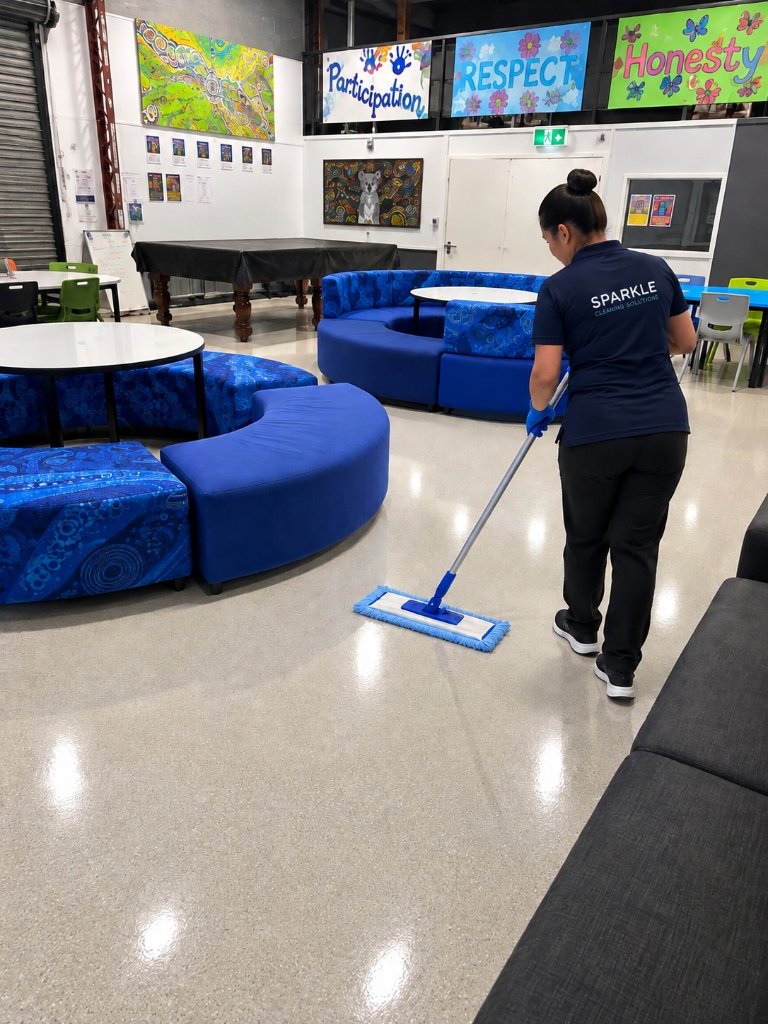
Why Microfibre Flat Mops Outperform String Mops
Traditional string mops dipped into a bucket of water quickly turn the bucket into a soup of suspended bacteria and soil. By the third room, the cleaner is simply mopping contaminated greywater across the floor.
Sparkle Cleaning Solutions utilises pre-impregnated microfibre flat mops:
- Mop heads are charged with clean, measured disinfectant solution in a sealed tub.
- A fresh, sterile mop pad is applied for each designated room or floor zone.
- Once a room is completed, the pad is peeled off and deposited into a sealed laundry hamper. It is never re-dipped into clean chemical solution.
The 8-Quadrant Microfibre Folding Method
Our cleaners are trained in the internationally recognised 8-fold technique. A microfibre cloth is folded in half and then in half again, creating eight distinct cleaning faces. As each surface is wiped, the operative turns to a fresh, uncontaminated quadrant, maximizing bio-burden capture and preventing surface re-soiling.
6. AS/NZS 4146 Compliant Laundering & Thermal Disinfection
A colour-coded system fails if all coloured cloths are thrown into the same washing machine on a cold rinse. At Sparkle, our laundering process complies strictly with Australian Standard AS/NZS 4146:2000 (Laundry Practice):
- Thermal Disinfection: Commercial washing machines maintain water temperatures of at least 65°C for a minimum of 10 minutes, or 71°C for 3 minutes, guaranteeing the thermal death of vegetative bacteria.
- Segregated Wash Loads: Red (washroom) and Yellow (clinical) cloths are washed in dedicated, isolated biohazard wash cycles separate from Blue and Green textiles.
- Microfibre Preservation: Cleaned with non-ionic neutral detergents without fabric softeners, which coat microfibre polyester/polyamide split filaments and destroy their electrostatic dirt-lifting capacity.
7. Quality Auditing & ATP Bioluminescence Verification
How do facility managers know that colour-coded protocols are actually being followed after hours? Sparkle bridges the trust gap with verifiable operational technology:
- Digital Quality Auditing: Designated Area Operations Managers conduct bi-weekly site inspections using cloud-based QA software, capturing photographic proof of colour-coded tool compliance, tidy janitorial caddies, and chemical SDS registers.
- ATP Bioluminescence Surface Swabbing: For clinical and food clients, we utilise rapid adenosine triphosphate (ATP) luminometer swabs. ATP is the energy molecule present in all living organic matter. Swabbing a surface delivers an objective Relative Light Unit (RLU) benchmark in 15 seconds, proving that a surface is biologically decontaminated.
8. Frequently Asked Questions by Facilities & Practice Managers
Facility Manager Inspection Checklist
Next time you inspect your facility’s cleaner storage room, check for these 5 telltale compliance indicators:
- ✓ Are mops, buckets, and microfibres visibly separated into distinct colour categories?
- ✓ Is there an official colour-coding chart mounted clearly on the cleaner cupboard wall?
- ✓ Are mop handles and chemical spray trigger bottles colour-coded to match the cloths?
- ✓ Are string mops eliminated in favour of flat-mop systems with fresh-pad protocols?
- ✓ Does your cleaning provider provide verifiable digital audit logs confirming compliance?
Upgrade to Managed, Certified Commercial Hygiene
Protect your team, clients, and brand reputation with Sparkle’s audit-backed commercial cleaning services across Sydney, Brisbane, Gold Coast, and regional hubs.

Sparkle Cleaning Solutions manages commercial, clinical, and corporate facilities across New South Wales and Queensland. Our operations adhere strictly to AS/NZS standards, Safe Work Australia frameworks, and ISO quality management guidelines.